
Arizona Real Estate Investment Guide 2026: Desert Growth + No Rent Control

Why Arizona Ranks #5 for Real Estate Investment in 2026
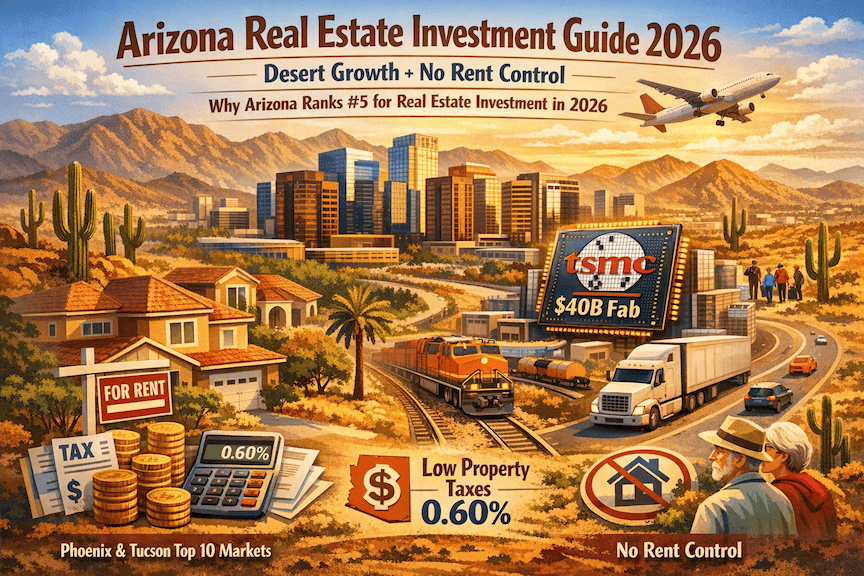
Arizona combines landlord-protective eviction laws (5-day notice), statewide rent control preemption, and Phoenix metro’s explosive expansion (75,000+ annual migrants from California/Washington), driving 2.6% GDP growth. With property taxes averaging just 0.60% (2nd lowest nationally after Hawaii), no state-level short-term rental restrictions, and two metros in the top 10 investment markets (Phoenix, Tucson), Arizona offers investors West Coast appreciation potential at Midwest pricing, anchored by semiconductor manufacturing (TSMC $40B fab), logistics dominance, and retiree influx across the Sun Corridor.
- Why Arizona Ranks #5 for Real Estate Investment in 2026
- Why Arizona Delivers West Coast Returns Without West Coast Taxes
- Legislative Landscape: The West's Most Landlord-Friendly Framework
- Top 3 High-Growth Metropolitan Statistical Areas (MSAs)
- Investment Risk Profile: Balanced Assessment for 2026
- FAQ Section:
- Lender Perspective: Optimal Loan Products for Arizona Investments
Why Arizona Delivers West Coast Returns Without West Coast Taxes
Macro Economic Drivers (2026 Data)
Population Growth:
- +1.8% annual growth rate (4th fastest in US)
- Net domestic migration: 120,000 residents annually (75% from California, Washington, Oregon)
- Phoenix metro: 200+ new residents daily, 5th largest US metro
- No-tax migration: California exodus accelerates (13.3% income tax → 2.5% in AZ)
GDP Performance:
- Arizona GDP: $485 billion (20th largest state economy)
- 2026 projected growth: 2.6% (exceeds national 2.1% forecast)
- Key sectors: Technology/semiconductors (15% of GDP, TSMC boom), logistics (12%, West Coast gateway), healthcare (11%, retiree services), tourism (8%, Grand Canyon/Scottsdale)
Employment Landscape:
- Unemployment rate: 3.6% (December 2025)
- Job creation: 73,000 net new jobs in 2025
- Fortune 500 presence: 8 HQs (PetSmart, Avnet, Insight Enterprises)
- Major expansions (2023-2025): TSMC ($40B semiconductor fabs, 13,000 jobs), Intel ($20B chip expansion), Tesla (Gigafactory rumors), Amazon (12 fulfillment centers)
Tax Advantages:
- State income tax: 2.5% flat rate (down from 4.5% in 2022, competitive with Florida/Tennessee)
- Property tax: 0.60% average (2nd lowest nationally, only Hawaii lower)
- No inheritance or estate tax
- Transaction Privilege Tax (TPT): Sales tax on rental income (varies by city, typically 1.5-3%)
Legislative Landscape: The West’s Most Landlord-Friendly Framework
Eviction Process Efficiency
5-Day Notice to Quit (Non-Payment):
- Arizona Revised Statutes §33-1368 allows landlords to issue 5-day notice for rent default
- Immediate filing: After 5 days, landlord can file eviction (no grace period)
- Average eviction timeline: 3-5 weeks from notice to writ of restitution
- No “just cause” requirement for lease non-renewal (except subsidized housing)
Court Process:
- Justice Court handles evictions (fast-track residential dockets)
- Summons: Tenant has 5 days to respond
- Hearing: Scheduled within 3-10 days if tenant contests
- Writ of restitution: Issued 12 hours to 5 days post-judgment
- Constable enforcement: 24-48 hour tenant removal
Pro-Landlord Provisions:
- Self-help evictions allowed (Arizona is one of few states permitting lockouts after court order)
- Tenant abandonment: 5-day notice of intent to retake possession
- Damage claims: Full lease term damages recoverable post-eviction
Rent Control Preemption
Arizona Revised Statutes §33-1329:
- State law prohibits municipalities from enacting rent control ordinances
- Full pricing autonomy for landlords in all 15 counties
- No rent increase caps or notice requirements (except lease terms)
Security Deposit & Lease Terms
Security Deposit Rules (ARS §33-1321):
- 1.5 months’ rent cap (residential leases)
- Return timeline: 14 business days with itemized deductions
- Pet deposits: Allowed, typically 0.5-1 month rent (separate from security deposit)
- Move-in fees: Allowed but must be reasonable (typically $200-$500)
Late Fees:
- No statutory cap (must be “reasonable”)
- Industry standard: $50-$100 or 5-10% of rent after 5-day grace period
Lease Terms:
- No mandatory renewal notice (except month-to-month requires 30 days)
- Landlord entry: 2 days’ notice required (ARS §33-1343)
Short-Term Rental Regulations
State-Level Framework:
- Arizona SB 1350 (2016): Prohibits cities from banning or restricting STRs (landmark landlord protection)
- Transaction Privilege Tax (TPT): 5.6% state tax + 1-4% local hotel tax
- HOA restrictions: Allowed, but cannot retroactively ban STRs if permitted at purchase
Local Variations:
- Phoenix: Registration required ($200/year), primary residence requirement repealed (2024), open market
- Scottsdale: Minimal restrictions, luxury STR hub ($400-$800/night)
- Tucson: Registration required ($150/year), noise ordinances
- Sedona: Tourist-dependent, unrestricted STRs in resort zones
- Flagstaff: University town, requires an owner-occupied or property manager within 60 miles
Opportunity: Arizona captures $3.8B annually in STR revenue (4th-highest nationally), with Scottsdale averaging $ 75 K – $120K per luxury property per year.
Property Tax & Appraisal System
Limited Property Value (LPV) System:
- 5% annual cap on assessed value increases for owner-occupied properties
- No cap for investor properties (but market-rate assessments typically increase 3-7% annually)
- Appeals process: County Assessor, then State Board of Equalization
Tax Rates by Metro:
- Phoenix (Maricopa County): $0.63 per $100 assessed value = 0.63% effective rate
- Scottsdale (Maricopa County): $0.54 per $100 = 0.54% effective rate
- Tucson (Pima County): $0.98 per $100 = 0.98% effective rate
- Mesa (Maricopa County): $0.68 per $100 = 0.68% effective rate
Strategy: Arizona’s 0.60% average property tax yields 12-18% higher cash flow than Texas (1.60%), New Jersey (2.49%), or Illinois (2.23%).
Top 3 High-Growth Metropolitan Statistical Areas (MSAs)
1. Phoenix-Mesa-Scottsdale MSA
Population: 5.1 million (5th largest in US, +1.9% annual growth)
Median Home Price: $455,000
Average Rent: $2,100 (single-family), $1,750 (multifamily)
12-Month Appreciation: +4.8%
Cap Rate Average: 5.2% (multifamily), 5.9% (single-family rentals)
Economic Anchors:
- Semiconductor boom: TSMC ($40B, 2 fabs, 13,000 jobs), Intel ($20B expansion, 3,000 jobs), Microchip Technology
- Logistics hub: Amazon (12 fulfillment centers), UPS Southwest hub, Phoenix Sky Harbor (#3 cargo airport)
- Healthcare: Mayo Clinic, Banner Health, HonorHealth (180,000 healthcare employees)
- Financial services: American Express, JPMorgan Chase, Wells Fargo operations centers
Investment Zones:
- Surprise/Goodyear (West Valley): Suburban growth, $380K-$500K, family rentals, A-schools, 6-7% CoC
- Queen Creek/San Tan Valley (Southeast): Master-planned communities, $400K-$550K, 6-8% yields
- Tempe/Chandler: Tech corridor, $500K-$700K, ASU/Intel proximity, 5-6% CoC
- Downtown Phoenix: Condos/lofts, $350K-$600K, urban renewal, ASU downtown campus
Investment Thesis:
- California exodus: 75,000+ annual migrants fleeing 13.3% income tax
- TSMC multiplier: 13,000 direct jobs + 50,000 indirect (suppliers, services) by 2028
- Water security: CAP (Central Arizona Project) ensures supply through 2050+
Risk Factor: Summer heat (115°F+) limits outdoor appeal June-August, but A/C standard makes rentals viable year-round.
→ Read the full Phoenix Market Spotlight
2. Tucson MSA
Population: 1.1 million (+1.0% annual growth, stabilizing)
Median Home Price: $335,000
Average Rent: $1,550 (single-family), $1,300 (multifamily)
12-Month Appreciation: +3.6%
Cap Rate Average: 6.4% (better cash flow than Phoenix)
Economic Anchors:
- Aerospace/defense: Raytheon Missiles & Space (12,000 employees, $1.8B payroll), Davis-Monthan Air Force Base (10,000 military/civilian)
- University of Arizona: 47,000 students, $2.5B annual economic impact
- Optics/photonics: “Optics Valley” designation, 150+ companies
- Border economy: Port of Nogales (Mexico trade), logistics/warehousing
Investment Zones:
- Oro Valley/Marana (Northwest): Master-planned, $380K-$550K, retiree + family demographics, 5-6% CoC
- Catalina Foothills: Luxury market, $600K-$1.5M, Ventana/La Paloma resorts
- Central Tucson (University District): Student rentals, $250K-$400K, 7-9% yields (high turnover)
- South Tucson: Value plays, $200K-$300K, 8-10% CoC (crime risk requires screening)
Investment Thesis:
- Affordability: 26% cheaper than Phoenix, attracts priced-out buyers
- Snowbird market: 40,000+ winter retirees (October-April occupancy boost)
- University stability: 47,000 students = recession-resistant rental demand
Opportunity: Tucson’s student rental market (7-9% yields) + snowbird demand = seasonal STR hybrid strategy.
→ Read the full Tucson Market Spotlight
3. Scottsdale (Luxury Submarket within Phoenix MSA)
Population: 245,000 (affluent enclave)
Median Home Price: $750,000
Average Rent: $3,200 (single-family), $2,500 (multifamily)
12-Month Appreciation: +3.9%
Cap Rate Average: 4.2% (appreciation play, not cash flow)
Economic Profile:
- Tourism: 7.5 million visitors annually, PGA tournaments, Barrett-Jackson auctions
- Corporate relocations: Remote executives, tech founders (no income tax incentive)
- Healthcare/wellness: Mayo Clinic Scottsdale, medical tourism
- Retail/hospitality: Fashion Square (#1 AZ shopping destination), 70+ golf courses
Investment Zones:
- Old Town Scottsdale: Condos/townhomes, $500K-$1M, walkable nightlife, STR goldmine
- North Scottsdale (Desert Ridge, DC Ranch): Single-family, $800K-$2M, executive rentals, 3-4% CoC
- South Scottsdale: Value plays, $600K-$900K, 4-5% yields, gentrifying
- Paradise Valley border: Ultra-luxury, $2M-$10M, celebrity enclave (limited investor access)
Investment Thesis:
- Constrained supply: Desert preservation limits new construction (NIMBYism)
- Luxury STR: $400-$800/night rates, PGA/spring training events, $75K-$120K annual income
- Tax-free wealth preservation: High-net-worth individuals parking capital
Risk Factor: Luxury market sensitivity to recession, but constrained supply provides downside protection.
→ Read the full Scottsdale Market Spotlight
Investment Risk Profile: Balanced Assessment for 2026
Risks to Monitor
1. Water Security Perception
- Reality: CAP (Central Arizona Project) ensures Phoenix supply through 2050+, but Lake Mead drought coverage
- Impact: National media narrative suppresses some buyer interest
- Mitigation: Phoenix metro (90% of AZ population) has secured rights; Tucson has diversified aquifers
2. Extreme Heat & Climate
- Challenge: 115°F+ summers (June-August), A/C costs $250-$400/month peak season
- Insurance: Homeowners insurance +25% since 2020 (wildfire risk in rural areas)
- Mitigation: Factor A/C costs into rent, target energy-efficient properties (post-2010 construction)
3. California Buyer Competition
- Effect: 75,000+ annual CA migrants drive bidding wars, compress yields
- Pricing: Phoenix now 60% of San Diego prices (up from 40% in 2018)
- Mitigation: Target secondary markets (Casa Grande, Apache Junction, Prescott) for better entry
4. Boom-Bust Cyclicality
- History: Phoenix led 2008-2012 crash (-55% peak-to-trough), but also led recovery (+120% 2012-2021)
- Current: More diversified economy (tech, logistics, healthcare vs. 2000s construction bubble)
- Mitigation: Buy below replacement cost, focus on job growth submarkets (Chandler, Surprise)
Strengths Mitigating Risks
Demographic Tailwinds:
- Retiree influx: 10,000 Baby Boomers daily, 30% consider Arizona (warm weather, no tax on retirement income)
- Remote work: Phoenix is #3 US destination for remote tech workers (after Austin, Miami)
- International buyers: Canadian snowbirds, Mexican nationals (proximity advantage)
Infrastructure Investment:
- Loop 202 South Mountain Freeway: $1.9B Phoenix beltway (completed 2023)
- I-10 Broadway Curve: $1.5B Tempe/Chandler corridor widening (2025-2026)
- Phoenix Sky Harbor Modernization: $1.1B terminal upgrade (2024-2028)
- Phoenix-Tucson high-speed rail: Proposed, environmental study phase
Institutional Capital Confidence:
- $11.2 billion in Arizona multifamily acquisitions (2024-2025) by Blackstone, Starwood, CBRE
- Single-family rental: Invitation Homes and American Homes 4 Rent own 14,500+ AZ homes
FAQ Section:
Lender Perspective: Optimal Loan Products for Arizona Investments
DSCR Loans (Debt Service Coverage Ratio)
- Best for: Cash-flowing properties in Tucson, Phoenix suburbs, secondary markets
- Typical terms: 80% LTV, 1.15x-1.25x DSCR requirement, 7.5-8.8% rates (2026)
- No income verification: Ideal for out-of-state CA investors, self-employed
- Arizona advantage: Low property taxes (0.60%) improve DSCR ratios by 12-18% vs. Texas/IL
- Lender recommendation: LenderTribune.com/loans specializes in Arizona DSCR programs
Fix & Flip Loans
- Best for: Phoenix gentrification zones (Roosevelt Row, Garfield), Tucson central, Mesa
- Terms: 90% of purchase + 100% of rehab, 9-12 month terms, 10-13% rates
- Exit strategy: Sell retail (strong CA buyer demand) or refinance into long-term rental
- Sweet spot: $300K-$500K purchase price for highest margins
Short-Term Rental Financing
- Best for: Scottsdale luxury homes, Phoenix Old Town, Sedona red rock properties
- Terms: 75-80% LTV, DSCR based on STR income projections (AirDNA reports), 8.5-10% rates
- Requirement: 6-12 months operating history or strong market comps
- Advantage: Scottsdale properties underwrite at $6,000-$10,000/month STR income vs. $3,000 long-term rent
Portfolio Loans
- Best for: Investors with 5+ Arizona properties across metros
- Terms: Cross-collateralization, blanket financing, 6.8-8.2% rates
- Advantage: Simplified underwriting, relationship pricing, faster closings (14-21 days)
Ready to leverage Arizona’s tax-free growth and landlord-protective framework?
- Explore Arizona Investment Properties →
- Get Pre-Approved for Arizona DSCR Loans →
- Download: Arizona Market Data Dashboard (2026) →
- Read City Spotlights: Phoenix | Scottsdale | Tucson | Mesa
Related State Guides:
- Texas Real Estate Investment Guide 2026
- Florida Real Estate Investment Guide 2026
- Nevada Real Estate Investment Guide 2026
Top Arizona City Spotlights:
Last Updated: February 2026 | Data Sources: US Census Bureau, Arizona Regional MLS, FRED Economic Data, Arizona Revised Statutes, LenderTribune Market Research
Disclaimer: This guide is for informational purposes only and does not constitute financial or legal advice. Consult with licensed professionals before making investment decisions.