
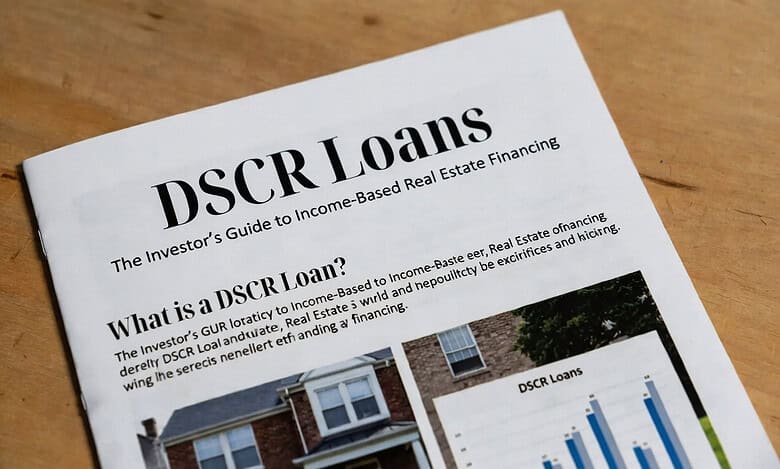
DSCR Loans: The Investor’s Guide to Income-Based Real Estate Financing
For real estate investors, W-2 income has always been the gatekeeper. Traditional lenders demand tax returns, pay stubs, and debt-to-income ratios that make scaling a rental portfolio feel nearly impossible — especially after the first few properties. DSCR loans change the equation entirely.
Debt Service Coverage Ratio (DSCR) loans are underwritten on the property’s cash flow, not the borrower’s personal income. If the rental income exceeds the monthly debt service, you qualify. It’s that simple — and that powerful.
What Is a DSCR Loan?
A DSCR loan is a type of non-QM (non-qualified mortgage) product designed specifically for real estate investors who own income-producing properties. The lender’s primary underwriting question isn’t ‘How much do you earn?’ — it’s ‘Does this property pay for itself?’
The Debt Service Coverage Ratio formula is straightforward:
DSCR = Gross Monthly Rental Income ÷ Monthly Debt Service (PITI)
Where PITI = Principal + Interest + Taxes + Insurance (and HOA if applicable). Most lenders require a minimum DSCR of 1.0x to 1.25x, meaning the property generates at least 100%–125% of its debt payments in gross rents.
DSCR Loan Requirements at a Glance
| Requirement | Typical Range | Notes |
| Minimum DSCR | 1.0x – 1.25x | 1.0x = break-even; 1.25x preferred |
| Credit Score | 620 – 680 minimum | Better rates above 740 |
| Down Payment | 20% – 25% | Some programs allow 15% with higher rate |
| Loan Amount | $100K – $3M+ | Varies by lender |
| Property Types | SFR, 2-4 units, Condos, Small MF | Some lenders cover 5–10 units |
| Loan Terms | 30-yr fixed, ARM, IO available | Interest-only improves DSCR math |
Who Are DSCR Loans For?
DSCR loans are purpose-built for:
- Self-employed investors whose tax write-offs lower their reported income
- High-volume investors who own 10+ properties and exceed conventional loan limits
- Foreign national investors who lack U.S. income documentation
- BRRRR investors looking for a clean, fast refinance exit after a rehab
- Operators building a buy-and-hold rental portfolio at scale
The BRRRR Method and DSCR: The Perfect Exit Strategy
If you’re familiar with the BRRRR method — Buy, Rehab, Rent, Refinance, Repeat — then DSCR loans are the missing link that makes the ‘Refinance’ step work for investors at scale. After acquiring a distressed property with a hard money loan, completing the rehab, and placing a tenant, a DSCR refinance lets you pull out your equity based on the new appraised value and the stabilized rent roll — without ever showing a W-2.
How DSCR Loans Are Priced
Expect DSCR loan rates to run 0.5% to 1.5% higher than conventional investment property rates, reflecting the added risk profile. Key pricing factors include:
- DSCR ratio: Higher DSCRs (1.3x+) earn better pricing
- Loan-to-Value (LTV): Lower LTV = lower rate. 65% LTV gets you the best tier
- Credit score: 740+ FICO unlocks the best rate grids
- Property type: Single-family rates beat small multifamily rates
- Loan term: Interest-only periods are available and can dramatically improve DSCR math for marginal deals
DSCR Loan vs. Conventional Investment Property Loan
| Feature | DSCR Loan | Conventional Inv. Loan |
| Income Verification | Property cash flow only | Full W-2, tax returns, DTI |
| Max Properties | Unlimited (most lenders) | 10 financed properties (Fannie/Freddie) |
| LLC Ownership | Yes — most lenders allow | No — must be in personal name |
| Closing Speed | 2–4 weeks | 30–45 days |
| Rate | 6.5% – 9%+ (current market) | 6%–7.5% (current market) |
| Best For | Scale investors, self-employed | First or second investment property |
Common Questions About DSCR Loans
Can I use a DSCR loan to purchase a vacation rental (STR)?
Yes. Many DSCR lenders will accept short-term rental income from Airbnb or VRBO, but they typically require 12 months of rental history or a third-party STR market analysis (such as an AirDNA report) in place of a standard lease agreement.
Can I close a DSCR loan in an LLC?
This is one of the DSCR loan’s most powerful features. Unlike Fannie Mae or Freddie Mac loans, most DSCR lenders are portfolio lenders that allow — and often prefer — LLC ownership. This provides liability protection for your entire portfolio.
What if my DSCR is below 1.0x?
Some lenders offer ‘No-Ratio’ DSCR loans (sometimes called DSCR 0.75x programs) for properties where rents don’t fully cover the debt service. These come at a higher rate and require a larger down payment, but allow investors to acquire properties in high-appreciation, lower-yield markets.
How to Apply for a DSCR Loan
The documentation package for a DSCR loan is refreshingly lean compared to conventional mortgages. Prepare:
- A signed lease agreement or market rent appraisal (Form 1007 or 1025)
- Property insurance declarations page
- 12 months of mortgage statements on existing financed properties
- Entity documents if closing in an LLC (Articles of Organization, Operating Agreement, EIN)
- Photo ID and authorization to pull credit
Most lenders can issue a pre-approval in 24–48 hours with this package and close in as little as 14–21 days.
The Bottom Line on DSCR Loans
DSCR loans are the workhorse of the modern real estate investor’s financing toolkit. They remove the most significant bottleneck to portfolio growth — personal income documentation — and replace it with a single, property-level underwriting standard. If you’re building a rental portfolio, scaling past 4 financed properties, or executing the BRRRR strategy, a DSCR loan should be a core part of your financing playbook.
Ready to get pre-approved? Lender Tribune connects you with top DSCR lenders nationwide. Submit your scenario for a same-day quote.
You may also like:
- Commercial Bridge Loans — Use cases (vacant properties, value-add, time-sensitive closings), LTC vs. LTV distinction, exit strategies (agency refi, CMBS, life co), and a hard money differentiation section
- Mezzanine Financing & Preferred Equity — The full capital stack explained with a 4-layer table, mezz vs. preferred equity side-by-side, blended cost modeling example, and capital provider types
- Fix-and-Flip Loans — The 70% Rule, complete draw schedule mechanics, itemized rehab budget framework, contractor protection guidelines, and a sample deal P&L
- Invoice Factoring vs. A/R Financing — Structure-level distinction (sale vs. collateral), recourse vs. non-recourse factoring, annualized cost calculation, and industry use cases SBA 504 vs. 7(a) — The 3-tranche 504 structure explained, side-by-side feature table, eligibility basics, and when to combine programs
- Merchant Cash Advances — True APR calculation table, the stacking debt trap illustrated step-by-step, the 5 alternatives to try first, and contract red flags (including confession of judgment clauses)
- Commercial Equipment Financing & Sale-Leaseback — Loan vs. lease comparison, sale-leaseback mechanics, two real-world case studies (construction and manufacturing), and Section 179 bonus depreciation tax notes