Private Lender Commercial Mortgage Rates 2026: Full Rate Comparison vs. Banks

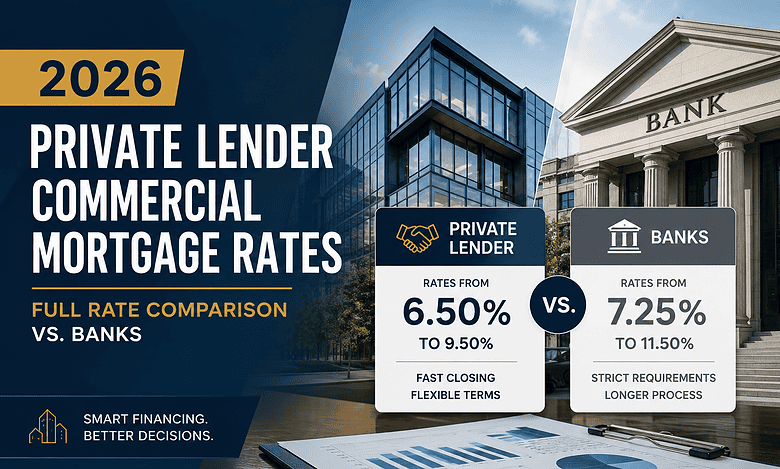
Current Private Lender Commercial Mortgage Rates (2026)
Private commercial mortgage rates in 2026 reflect a higher-for-longer rate environment combined with tightening credit spreads as capital competition increases among debt funds and private lenders. Rates vary significantly by loan type, asset class, leverage, and borrower profile.
| Loan Type | Rate Range (2026) | Term | Typical Points |
|---|---|---|---|
| Bridge Loan (stabilized) | 9.00% – 11.50% | 12–24 months | 1.0–2.0 |
| Bridge Loan (value-add) | 10.00% – 12.50% | 12–36 months | 1.5–2.5 |
| Hard Money (commercial) | 10.50% – 13.00% | 6–24 months | 2.0–3.0 |
| DSCR Permanent (private) | 7.50% – 9.50% | 5–30 years | 0.5–1.5 |
| Construction (private) | 10.50% – 13.50% | 12–24 months | 2.0–3.0 |
| Mezzanine / Preferred Equity | 12.00% – 16.00% | 12–36 months | 1.0–2.0 |
| Non-Recourse Bridge (debt fund) | 9.50% – 11.00% | 24–36 months | 1.0–1.5 |
Rates current as of 2026. Actual rates depend on LTV, DSCR, asset class, market, and borrower profile. These ranges represent institutional-quality private lenders, not fringe hard money operators.


Private vs. Bank vs. CMBS: Rate Comparison Table
The rate gap between private lenders and traditional sources is real, but it narrows considerably when you factor in underwriting standards, execution certainty, and the true cost of a deal falling through at a bank.
| Lender Category | Typical Rate Range | Points | Close Time | Income Docs Required | Flexibility |
|---|---|---|---|---|---|
| National Bank | 6.50% – 7.50% | 0–0.5 | 45–90 days | Full (tax returns, W-2) | Low |
| Regional / Community Bank | 6.75% – 8.00% | 0–0.5 | 30–60 days | Full | Medium |
| Credit Union | 6.50% – 7.75% | 0–0.25 | 30–45 days | Full | Low–Medium |
| CMBS / Conduit | 6.75% – 7.75% | 0.5–1.0 | 45–75 days | Property-level financials | Low |
| Debt Fund (bridge) | 9.00% – 11.50% | 1.0–2.0 | 14–30 days | Light / DSCR | High |
| Private / Hard Money | 10.00% – 13.00% | 2.0–3.0 | 7–21 days | Minimal / asset-based | Very High |
| SBA 504 (owner-occ) | 6.00% – 7.00% | 0–0.5 | 60–120 days | Full (business + personal) | Very Low |
What Drives Private Lender Rates
Private commercial mortgage rates aren’t arbitrary. They’re priced based on a clear set of risk variables. Understanding each factor helps you negotiate better terms and present a stronger borrower profile.
Loan-to-Value (LTV)
The single biggest rate driver. A 60% LTV loan will price 75–150 basis points lower than the same loan at 75% LTV. Private lenders protect themselves through equity first; the rate premium you pay at higher leverage reflects real additional risk, not arbitrary pricing.
DSCR
Lenders price tighter on loans with DSCR of 1.30x or above. A deal barely clearing 1.10x will carry a higher rate to compensate for thin cash flow coverage.
Asset Class
Multifamily and industrial get the best private market pricing in 2026. Retail, office, and hospitality carry risk premiums of 50–150 basis points depending on market, vacancy, and lease structure.
Market Tier
Primary markets (NYC, LA, Chicago, Miami, Dallas) price tighter than secondary and tertiary markets where liquidity at exit is less certain.
Loan Size
Larger loans ($5M+) typically access better pricing due to efficiency. Very small loans ($500K–$1M) often face minimum origination requirements that effectively increase the cost.
Borrower Experience
Experienced operators with documented track records access lower-rate tiers. First-time commercial borrowers pay a premium until they establish a track record.
When Paying a Higher Rate Makes Financial Sense
The common mistake is comparing private rates to bank rates in isolation. The real question is: what is the cost of NOT closing this deal?
Time-Sensitive Acquisitions
If your purchase agreement has a 21-day financing contingency, a bank cannot close it. Period. A private lender can. The 3–4% rate premium on a 12-month bridge loan on a $2M purchase costs roughly $60,000–$80,000 annually — a fraction of the equity captured in a well-priced acquisition.
Value-Add Business Plans
Banks won’t lend on a property at 50% occupancy. Private bridge lenders will. Bridging from acquisition to stabilization is precisely the use case that justifies private pricing.
Non-Bankable Borrower Profiles
Strong asset, thin personal income documentation. Foreign national. Recent credit event. Business in a non-bankable sector. Private lenders evaluate these deals on their merits and price accordingly.
Construction and Ground-Up Deals
Bank construction financing has become increasingly conservative post-2022. Private construction lenders fill the gap for spec builds, custom homes, and commercial ground-up projects that banks won’t touch.
Calculating the True Cost of a Private Commercial Loan
| Component | Example (Bridge Loan) | Notes |
|---|---|---|
| Loan Amount | $1,500,000 | |
| Interest Rate | 10.50% | Annual |
| Term | 18 months | |
| Origination Points | 2.0% = $30,000 | Paid at closing |
| Exit Fee | 0.5% = $7,500 | Paid at payoff |
| Total Interest (18 mo.) | $236,250 | Interest-only |
| Total Cost of Capital | $273,750 | Points + interest + exit |
| Effective Annual Rate | ~12.2% | All-in over 18 months |
The all-in cost is higher than the headline rate suggests. Always calculate total carry cost—including origination, exit fees, and any prepayment penalties—before accepting a term sheet.
Frequently Asked Questions
What are typical private lender commercial mortgage rates in 2025?
Private lender commercial mortgage rates in 2026 range from approximately 7.50% for permanent DSCR loans to 13.50% for ground-up construction. Bridge loans from institutional debt funds typically price between 9.00% and 11.50%. Hard money lenders occupy the 10.50%–13.00% range. Rates depend on LTV, DSCR, asset class, and borrower experience.
How much higher are private lender rates vs. bank rates?
Private bridge and hard money rates typically run 250–550 basis points above conventional bank commercial mortgage rates. However, private DSCR permanent loans from debt funds are now pricing within 100–200 basis points of bank rates in some scenarios, especially for stabilized multifamily and industrial.
Are private lender commercial mortgage rates fixed or variable?
Bridge loans from private lenders are typically floating-rate, usually priced at a spread over SOFR or Prime. Permanent private DSCR loans may offer fixed or floating options depending on the lender. Construction loans are almost universally floating-rate. Always confirm the index, spread, and floor rate when reviewing a term sheet.
Do private commercial lenders charge prepayment penalties?
Short-term bridge and hard money loans typically have a minimum interest period (often 3–6 months) rather than a traditional prepayment penalty. Permanent private DSCR loans may include step-down prepayment schedules or yield maintenance provisions. Review the prepayment section of the term sheet carefully before signing.
Can I negotiate private lender commercial mortgage rates?
Yes. Rates and fees on private commercial mortgages are negotiable, especially if you have a strong borrower profile, multiple competing term sheets, or an ongoing relationship with the lender. Reducing LTV, increasing reserves, or shortening the loan term can also improve pricing without direct negotiation.